
Companion planting is the practice of growing certain plants close together so they can help each other in useful ways. Some pairings reduce pest pressure. Some improve soil conditions. Others help conserve moisture, attract beneficial insects, or make better use of space in the garden.
At its core, companion planting is about working with natural plant relationships instead of treating every crop like it grows in isolation. When you understand a few simple combinations, you can build a garden that is more balanced, more productive, and often easier to manage.
It is not magic, and it is not an exact science in every yard. Still, companion planting gives gardeners a smart way to observe what works and use those patterns to their advantage.
What Companion Planting Actually Does
Many beginners hear the term and assume companion planting is only about keeping pests away. That is part of it, but the idea is broader than that.
A good plant pairing may help by:
- Deterring unwanted insects
- Attracting pollinators and beneficial insects
- Improving soil fertility
- Providing shade to the soil
- Reducing weed growth
- Making better use of vertical and horizontal space
- Supporting healthier overall plant growth
Some combinations are practical. Others are traditional. A few are simply useful because the plants fit well together in the same bed. Even when the benefits are modest, the right combinations can make your garden feel more efficient and easier to maintain.
The Three Sisters: A Classic Example of Companion Planting
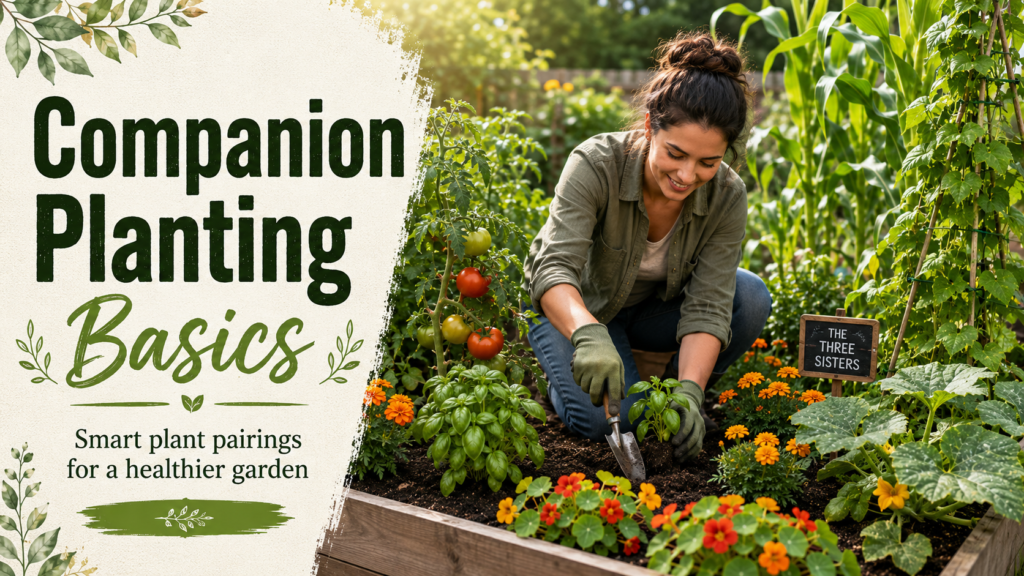
The best-known example of companion planting is the Three Sisters method: corn, beans, and squash grown together. Native American farmers used this method for centuries because each plant contributes something important to the group.
Corn grows tall and gives the beans a natural structure to climb. Instead of needing a separate trellis, the beans can use the corn stalks for support. Beans help the system by fixing nitrogen in the soil, which benefits heavy-feeding crops like corn. Squash spreads across the ground, shading the soil and helping hold in moisture while also reducing weed growth.
This combination works because each plant fills a different role. One grows up, one climbs, and one spreads low across the ground. Together, they use the space more completely than a single crop would on its own.
Why the Three Sisters still matter today
Even if you never plant this exact trio, it teaches an important lesson. Strong companion planting often comes from combining plants with different strengths. One may support. One may feed the soil. One may protect the surface of the bed.
That same thinking can help you plan almost any garden.
Basil and Tomatoes: A Popular Garden Pair
Basil and tomatoes are one of the most talked-about pairings in home gardening. Many gardeners believe basil helps improve tomato flavor and may also discourage pests such as aphids and whiteflies.
The flavor claim can be hard to prove in a strict scientific sense, but many gardeners swear by the combination. At the very least, basil and tomatoes grow well under similar conditions and make practical companions in the garden and in the kitchen.
That alone makes them a sensible pairing. They like warm weather, they fit well in the same bed or container, and they are often harvested around the same time. If a pairing is both useful in the garden and useful in the kitchen, it earns its place.
Marigolds: One of the Best Companion Plants for Beginners
Marigolds are among the easiest and most versatile companion plants you can add to a vegetable garden. They are bright, simple to grow, and helpful in more than one way.
Their roots are known for releasing compounds that can help deter certain soil nematodes. Their flowers also attract beneficial insects, which may help support a healthier garden ecosystem. On top of that, they add color and make the garden look more lively and intentional.
Because marigolds are so flexible, many gardeners tuck them throughout the garden rather than limiting them to one bed. They can work near vegetables, along borders, or anywhere you want a little extra support for natural pest management.
Why marigolds are worth planting
- Easy to grow
- Helpful for natural pest control
- Attractive to beneficial insects
- Useful in many parts of the garden
For many gardeners, marigolds are the simplest place to start with companion planting.
Nasturtiums: A Smart Trap Crop
Nasturtiums are another useful companion plant, especially when aphids are a problem. They are often used as a trap crop, which means they attract pests away from the plants you are trying to protect.
Aphids are strongly drawn to nasturtiums. Instead of spreading across your vegetables, they may gather on the nasturtium plants first. That gives you a chance to manage the problem in one place. If needed, you can remove the heavily affected nasturtiums and dispose of them, taking a large portion of the pest population with them.
This is one of the most practical ideas in companion planting. Instead of trying to stop every pest from entering the garden, you guide them toward a plant that can take the pressure.
Nasturtiums also have another advantage. They are attractive, easy to grow, and fit well into vegetable beds without feeling out of place.
Companion Planting Is Helpful, Not Perfect
One of the biggest mistakes gardeners make is assuming every companion planting chart will work exactly the same in every garden. Real gardens do not work that way. Soil, weather, pest pressure, spacing, and local conditions all affect the results.
That is why companion planting works best when you treat it as a tool, not a strict rulebook. Use common pairings as a starting point. Then pay attention to what actually happens in your own space.
You may find that one combination works beautifully for you, while another does very little. That is normal. Gardening always involves some trial and observation.
Observation Is the Most Important Rule
If there is one rule that matters most in companion planting, it is this: watch your garden closely.
Try pairings that make sense to you. Notice which plants seem healthier together. Watch where pests appear and where they stay away. Pay attention to shade, growth habits, and how each plant affects the bed around it.
Over time, your own experience becomes more valuable than any generic chart. Companion planting works best when it grows out of direct observation and repeated results in your own garden.
Start Simple and Build from There
You do not need to redesign your whole garden to use companion planting. Start with a few easy combinations. Add basil near tomatoes. Tuck marigolds through your vegetable beds. Try nasturtiums where aphids tend to show up. If you have the space, experiment with the Three Sisters method and see how the plants interact.
Small changes can teach you a lot. As you learn what works in your garden, you can build a planting style that feels more natural and more effective.
Companion planting is not about chasing perfect pairings. It is about building a garden where plants support one another whenever possible. That simple shift can lead to healthier crops, better use of space, and a more enjoyable growing season.